You reach for the top shelf, pull on a seatbelt, or roll onto your side at night, and there it is: a deep ache in the front or side of the shoulder that sometimes runs partway down the arm. It isn't bad enough to stop you, but it's been there for months, and it's starting to shape how you move.
That is one of the most common stories we hear at our Edgewater, MD office. Some people are boaters and weekend golfers from around Anne Arundel County. Others are painters, contractors, and parents who lift toddlers all day. Many simply can't point to a single moment when it started.
This post covers what is usually behind this kind of lingering shoulder pain, what the research does and doesn't say about shockwave therapy for shoulder pain, and where PulseWave fits into the care we provide at Maryland Chiropractic & Physical Medicine.
Why the shoulder is so easy to irritate
The shoulder trades stability for range of motion. No other joint in your body moves through as wide an arc, and much of the work of keeping the ball of the upper arm centered in its shallow socket falls to the rotator cuff, a group of four muscles and their tendons.
According to MedlinePlus from the National Library of Medicine, most rotator cuff injuries are wear-and-tear problems from repeating the same arm movements, especially reaching overhead. The same source notes that people over 40, athletes in sports such as tennis, swimming and baseball, and workers who reach overhead or lift heavy loads are more likely to develop them.
Above the rotator cuff sits a bony shelf called the acromion, with a small fluid-filled sac (the bursa) between them. When you raise your arm, that space gets smaller. The American Academy of Orthopaedic Surgeons' OrthoInfo describes how the tendon and bursa can get pinched and irritated there, which is often called impingement.
The common culprits behind lingering shoulder pain
"Shoulder pain" is a symptom, not a diagnosis. Sorting out the cause matters, because it determines which options make sense, including whether shock wave therapy is worth considering at all.
Rotator cuff tendinopathy
This is the broad term for a tendon that has become painful and less tolerant of load. It may start as irritation (often called tendinitis) and, if it lingers, can shift toward longer-term changes in how the tendon is organized. Typical signs include:
- Pain in the front or side of the shoulder, sometimes spreading toward the outside of the upper arm
- Pain when lifting the arm out to the side or reaching overhead
- Pain when lowering the arm back down
- Night pain, especially lying on the affected side
Calcific tendinitis
In some people, calcium deposits form inside a rotator cuff tendon, most often the supraspinatus at the top of the shoulder. The deposits can be silent for a long time and then become intensely painful. They show up on X-ray, which is one reason imaging can be helpful for a shoulder that isn't following the usual pattern. As you'll see below, calcific tendinitis is where the research on shock wave therapy is strongest.
Bursitis and impingement
Irritation of the bursa often travels with tendon problems. The pinch-point mechanics described above can keep both irritated.
Things that look like shoulder pain but aren't
Pain felt in the shoulder isn't always coming from the shoulder. A pinched nerve in the neck can send pain into the shoulder and arm. That is why OrthoInfo notes that a shoulder exam often includes the neck. Frozen shoulder (adhesive capsulitis), shoulder arthritis and rotator cuff tears are also on the list, and they call for different plans.
When shoulder pain needs prompt medical attention
Please seek prompt medical care, not a chiropractic visit, if you have:
- Sudden weakness or inability to lift the arm after a fall or heavy lift, which may indicate a tear
- A visible deformity after an injury
- Shoulder or arm pain together with chest pressure, shortness of breath, sweating or jaw pain, which can be a sign of a heart problem (call 911)
- Fever, redness and warmth over the joint
- Progressive numbness or weakness in the arm or hand
MedlinePlus advises that if your arm feels weak right after a sudden shoulder injury, you should see a provider as soon as possible.
What PulseWave is
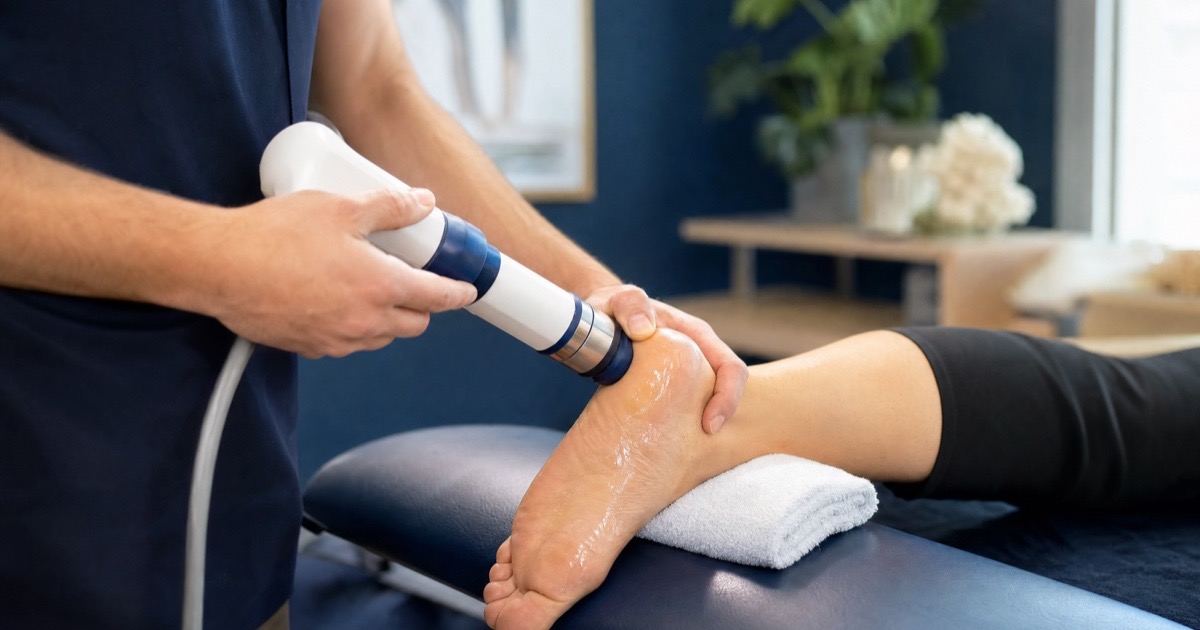
PulseWave is a shock wave therapy device. It delivers focused acoustic waves, rapid pulses of mechanical energy, through the skin to a targeted area. The goal isn't to heat the tissue or numb it. It is designed to stimulate the body's natural healing response in tissue whose repair process seems to have stalled.
Researchers are still working out exactly how shock wave therapy works. Proposed mechanisms include increased local blood flow, stimulation of tissue remodeling, and changes in how pain signals are processed. For a broader overview, see our post on what PulseWave therapy is or visit our PulseWave page.
What the research says about shock wave therapy for the shoulder
Here, the honest answer depends on which shoulder problem you have.
Calcific tendinitis: the strongest evidence
A 2014 systematic review published in the Annals of Internal Medicine (Bannuru et al.) pooled 28 randomized controlled trials. Across the trials comparing energy levels and placebo, high-energy shock wave therapy was consistently better than placebo for decreasing pain, improving function, and resorption of the calcium deposits in chronic calcific tendinitis. The authors concluded that the approach "may be underutilized for a condition that can be difficult to manage."
The same review, though, found no significant difference between shock wave therapy and placebo for non-calcific tendinitis, and it notes that the trials were small in number and varied widely in method.
Non-calcific rotator cuff tendinopathy: mixed, still developing
A 2024 systematic review and meta-analysis in BMC Musculoskeletal Disorders (Cui et al.) looked at 16 randomized trials with 1,093 patients with rotator cuff tendinopathy, both calcific and non-calcific. Compared with control groups, shock wave therapy was associated with better pain and function scores. The authors were careful to call this "currently limited evidence." Heterogeneity between studies was high, and they point out that another recent meta-analysis found only a slight short-term pain benefit over sham treatment for non-calcific cases.
What that means in practice
Putting it together:
- If imaging shows calcium in the rotator cuff, shock wave therapy is one of the better-studied non-surgical options.
- If the tendon is painful without calcium, the evidence is more mixed. Shock wave therapy may still be reasonable as part of a broader plan, but we'll tell you it's a less certain bet.
- Studies used many different devices, energy levels and protocols. Results from one study don't automatically carry over to every machine or every patient.
Individual results may vary, and no outcome is guaranteed. Part of our job is telling you when you're a reasonable candidate and when you're not.
Why PulseWave works best as part of a plan
A painful shoulder rarely comes down to one tissue. It usually involves how the shoulder blade moves, how much the upper back rotates, how the neck is doing, and how much load the tendon has been asked to handle lately. OrthoInfo describes stretching and a progressive rotator cuff strengthening program as core parts of non-surgical care.
At our office, PulseWave is typically one piece of a plan that may also include:
- Chiropractic adjustments for the upper back, ribs and neck, since a stiff thoracic spine can change how the shoulder blade moves
- Soft tissue work, massage therapy or cupping for the muscles around the shoulder blade and chest
- A home exercise program that starts gentle and progresses to rotator cuff and shoulder blade strengthening
- Activity changes so you can keep moving without constantly re-aggravating the tendon
You can see our full range of services and the conditions we commonly see.
What a PulseWave visit looks like
At your first visit, Dr. Curran takes a history and examines the shoulder, neck and upper back. That includes checking range of motion, strength, and which movements reproduce your pain. If something suggests a tear, a nerve problem or another issue that needs imaging or a specialist, we'll tell you and refer you.
If PulseWave makes sense, a session generally goes like this:
- Positioning: You sit or lie comfortably with the arm supported in a position that exposes the sore area.
- Locating the target: We find the most tender spots and apply a coupling gel.
- The session: The handpiece delivers rapid acoustic pulses. Most people describe it as a strong, deep tapping. It can be briefly uncomfortable over the most sensitive spots, and we adjust intensity as we go.
- Time: The PulseWave portion usually takes only minutes.
- Afterward: Most people go right back to their day. We'll give you guidance on activity and exercises.
PulseWave is usually delivered as a short series of sessions spaced about a week apart. When changes occur, they tend to build gradually over the series and can continue in the weeks after.
Who may not be a candidate
Shock wave therapy isn't right for everyone. Let us know if you:
- Are pregnant
- Take blood thinners or have a bleeding or clotting disorder
- Have an active infection, open wound, or skin condition over the area
- Have a tumor in or near the treatment area
- Have had a recent steroid injection in the shoulder
- Have a pacemaker or other implanted device near the area
- Have a known or suspected full-thickness rotator cuff tear
We review your health history before recommending anything and refer out when that's the right call.
Simple habits that may help your shoulder in the meantime
While you're figuring out next steps, a few general habits help many people:
- Don't stop moving it entirely. Gentle, pain-tolerable motion is usually better than keeping the arm still, which can lead to stiffness.
- Bring the work closer. Keep frequently used items between waist and shoulder height, and use a step stool instead of reaching overhead.
- Change how you sleep. Avoid lying on the sore side, and try hugging a pillow to keep the arm supported.
- Watch the desk setup. Hunched shoulders and a rounded upper back narrow the space the rotator cuff moves through. Our post on tech neck for desk workers has practical setup tips.
- Ramp up gradually. Returning to golf, tennis or painting the house? Build back over a few weeks instead of all at once.
Frequently asked questions
Does PulseWave hurt?
It can be uncomfortable over the most tender spots. Most people describe a strong tapping sensation. Sessions are short, and we adjust the intensity throughout.
How many sessions will I need?
It depends on the underlying problem, how long you've had it, and how you respond. PulseWave is typically delivered as a short series about a week apart. You'll get an honest estimate after your exam.
Do I need an X-ray or MRI first?
Not always. For a shoulder that isn't following the usual pattern, or when calcific tendinitis is suspected, imaging can help clarify what's going on. We'll let you know if we think it's worth getting and help coordinate a referral.
Is PulseWave the same as the ultrasound therapy I've had before?
No. Therapeutic ultrasound uses high-frequency sound mainly for gentle heating. PulseWave delivers higher-energy acoustic pressure waves designed to stimulate a tissue response. They're different tools.
Can I still golf, swim or lift weights?
Usually, with modifications. We'll help you adjust volume and intensity so you can stay active while the tendon adapts. Complete rest is rarely the goal.
Could my shoulder pain be coming from my neck?
It can. Nerve irritation in the neck can refer pain into the shoulder and arm. That's why we examine the neck and upper back as part of every shoulder evaluation.
Is shock wave therapy covered by insurance?
Shock wave therapy is generally not a covered benefit. We'll explain what's involved before you commit, and financing options are available.
Do I need a referral?
No. You can contact our Edgewater office directly to schedule an evaluation.
The bottom line
If your shoulder started bothering you a week or two ago, start with the basics: ease off the aggravating activity, keep it moving gently, and pay attention to how you sleep and work. Many people improve with that alone.
If it's been months, and especially if imaging shows calcium in the rotator cuff, you may be in the situation shock wave therapy is designed for. Alongside hands-on care and a progressive exercise program, PulseWave may support the body's natural healing response and is a non-surgical option worth understanding. The research is encouraging for calcific tendinitis and still developing for other rotator cuff problems, and we'll be upfront about which group you're in.
Shoulder pain care in Edgewater and Anne Arundel County
Maryland Chiropractic & Physical Medicine sees patients from across Anne Arundel County, including Edgewater, Annapolis, Davidsonville, Riva, Mayo, Crownsville, Severna Park and Arnold. Learn more about Dr. Curran and our team, or read our related posts on PulseWave for tennis elbow and PulseWave for Achilles tendon pain.
We're at 137 Mitchell's Chance Road, Suite 100, Edgewater, MD 21037. Call (443) 294-6873, book a PulseWave consultation, or send us a message.
Office hours: Monday & Thursday 8:30–12:30 and 2:30–6:30 · Tuesday 8:30–12 and 2–4 · Wednesday 8:30–2 · Friday 8:30–2:30
This article is for educational purposes only and is not medical advice. Individual results may vary. Shock wave therapy is not appropriate for every patient or every cause of shoulder pain, and no outcome is guaranteed. If you have sudden arm weakness after an injury, or shoulder pain with chest pressure or shortness of breath, seek emergency medical care. Talk with a qualified healthcare provider about your specific condition before beginning any new treatment.