The first few steps out of bed are the giveaway. The back of the heel is stiff and sore, it loosens up after you've walked around the kitchen for a few minutes, and then it comes back — worse — the morning after a long walk around downtown Annapolis or a weekend of yard work.
That pattern is the story we hear from a lot of people who come to our Edgewater, MD office with Achilles tendon pain. Some are runners training on the trails around Anne Arundel County. Many aren't athletes at all: they're people who changed shoes, started a new job on their feet, added pickleball, or simply ramped up their walking too quickly.
This post walks through what is actually going on in a sore Achilles, why it tends to linger, what the research does and doesn't say about shock wave therapy for Achilles tendinopathy, and where PulseWave fits in the care we provide at Maryland Chiropractic & Physical Medicine.
What the Achilles tendon does — and why it gets overloaded
The Achilles is the largest tendon in the body. It joins your calf muscles to your heel bone, and it loads every time you walk, climb stairs, jump, or push up onto your toes. It is built to handle enormous force, which is exactly why it gets into trouble when that force climbs faster than the tissue can adapt.
According to the American Academy of Orthopaedic Surgeons' patient resource on Achilles tendinitis, the condition usually isn't tied to one specific injury. It develops from repetitive stress, and common contributors include:
- A sudden jump in the amount or intensity of activity
- A change in footwear
- Tight calf muscles, which put extra stress on the tendon where it attaches to the heel
- An enlarged bony bump on the back of the heel (Haglund's deformity) that can rub on the tendon
"Tendinitis" vs. "tendinopathy"
You'll see both terms. "Tendinitis" implies inflammation. In longer-standing cases, the tissue tends to show microscopic wear and disorganized repair rather than classic inflammation, which is why many clinicians use the broader term tendinopathy. The AAOS notes the terms are often used interchangeably for the same problem.
The distinction matters for one practical reason: if a tendon has been sore for months, the goal usually isn't just to calm inflammation down. It's to help a stalled repair process get moving again while gradually rebuilding the tendon's capacity to handle load.
Two different kinds of Achilles pain
This is the part most people have never been told, and it changes the plan.
Mid-portion (non-insertional) Achilles pain
The sore spot is in the cord of the tendon itself, roughly two to six centimeters above the heel. The tendon may feel thickened or have a tender nodule. This version is more common in younger, active people — runners especially.
Insertional Achilles pain
The pain is right where the tendon attaches to the back of the heel bone. It is often aggravated by the back of a shoe pressing on it, and it may come with a bone spur or a Haglund's bump. It can show up at any age or activity level.
Why this matters: the two respond differently to the same exercises, and — as you'll see below — the research on shock wave therapy is noticeably stronger for one than the other. That's one of several reasons we examine before recommending anything.
When it's not "just tendinopathy"
If you felt a sudden pop in the back of your calf or heel — sometimes described as feeling like you were kicked — that can be an Achilles rupture. That needs prompt medical evaluation, not a wait-and-see approach and not shock wave therapy. Please call your physician or seek urgent care.
Why Achilles pain drags on
Tendons have relatively modest blood supply compared with muscle, and they adapt slowly. When load outpaces recovery for weeks at a time, the tissue can get stuck in a cycle: it hurts, you rest, it feels better, you go back to your previous activity level, and it flares again.
Rest alone often doesn't break that cycle, because rest reduces pain without rebuilding the tendon's tolerance to load. The AAOS points out that even with early treatment, symptoms can last longer than three months. That's frustrating, but it's normal — and it's why a patient, structured plan tends to beat stop-and-start fixes.
The conservative foundation
Before we talk about PulseWave, it's worth being clear that it is not the starting point for everyone. The AAOS describes the mainstays of nonsurgical care as activity modification, shoe changes, and physical therapy–style exercise, and in most cases these provide meaningful relief over time.
In our office, the foundation typically includes:
- Load management, not total rest. Swapping some running or high-impact work for cycling, the elliptical, or swimming so you stay active without repeatedly aggravating the tendon.
- Calf flexibility and strength. Gentle calf stretching and a progressive strengthening program. For mid-portion pain, slow heel-drop (eccentric) exercises are a well-established option. For insertional pain, the AAOS specifically cautions against heel drops off a step, so we modify the program — another reason the diagnosis comes first.
- Footwear and heel support. Shoes that are softer or open at the back of the heel, and sometimes a heel lift, can take pressure off an irritated insertion.
- Hands-on care up the chain. Ankle, knee, hip, and low-back mechanics all affect how load reaches the Achilles. Chiropractic care, soft tissue work, and massage therapy can help address stiffness and movement patterns that contribute to repeated strain.
One thing we steer people away from: the AAOS notes that cortisone injections into the Achilles tendon are not recommended, because they have been associated with weakening of the tendon and rupture risk.
Where PulseWave fits
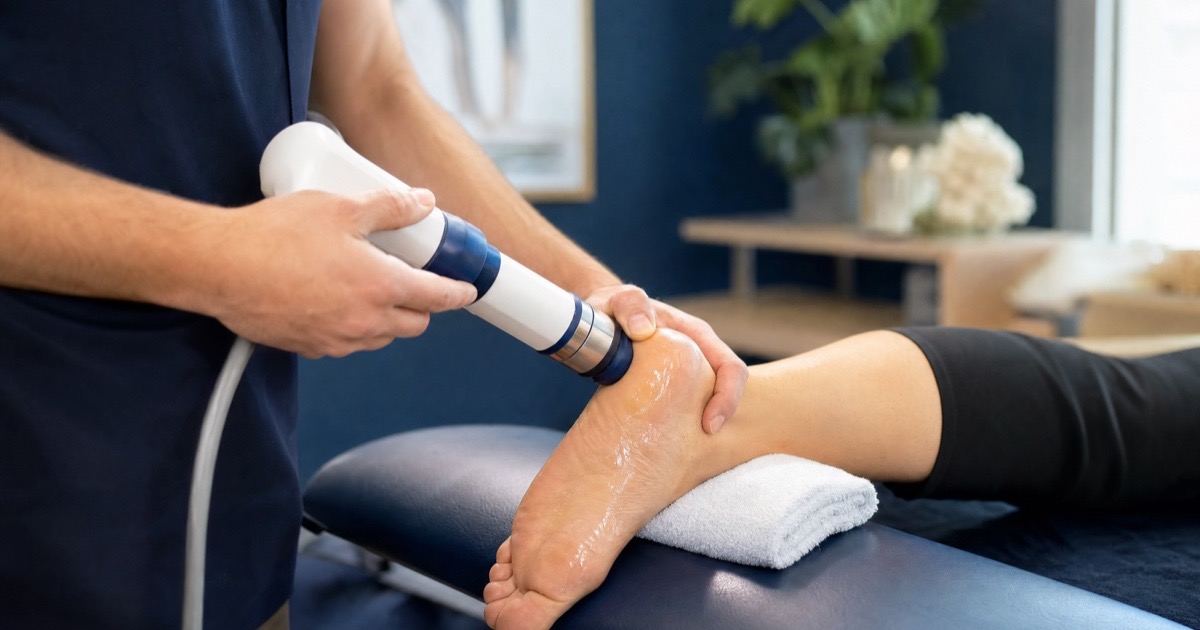
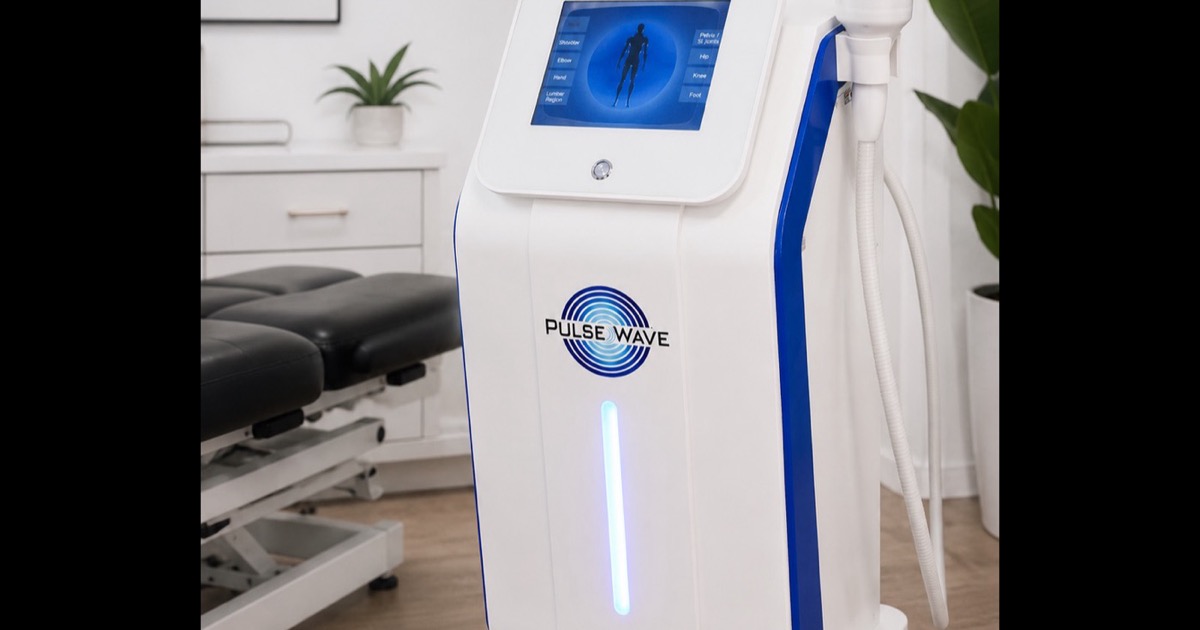
PulseWave is a form of acoustic wave therapy. It delivers focused acoustic waves through a handpiece placed against the skin over the painful area. Those pressure waves pass into the tissue and are designed to stimulate the body's natural healing response — including local circulation and the tissue-remodeling activity that a stalled tendon can be missing.
If you'd like the fuller plain-language explanation of the technology, I've written a separate overview of what PulseWave therapy is and how it works. You can also read about the PulseWave program at our office.
The AAOS describes shock wave therapy as an option for Achilles tendinitis, notes that low-energy protocols typically involve a short series of sessions without anesthesia, and characterizes it as low risk with few complications — while also noting that more information is needed before strong recommendations can be made for routine use. That is a fair and honest summary, and it's how we talk about it with patients.
What the research says
We want you to have the real picture, including where the evidence is thinner.
Mid-portion Achilles tendinopathy: moderate evidence, especially alongside exercise
A 2022 systematic review of randomized controlled trials in Sports Medicine – Open looked at mid-portion and insertional Achilles tendinopathy separately. For mid-portion pain, the authors found moderate-quality evidence that shock wave therapy improved outcomes compared with standard care — and specifically moderate evidence supporting shock wave therapy added to a tendon-loading program.
A separate 2022 systematic review in Cureus focused only on mid-portion Achilles tendinopathy. It included seven randomized trials, found consistent evidence across four of them that shock wave therapy helped reduce pain and improve function, and concluded that combining it with eccentric exercise and stretching may be more effective than shock wave therapy alone. The authors also called for more research to settle on the best protocol.
Insertional Achilles tendinopathy: the evidence is less settled
The same Sports Medicine – Open review concluded that evidence supporting shock wave therapy for insertional Achilles tendinopathy is lacking at this point. That doesn't mean it can't be part of a plan for insertional pain, but it does mean we're more cautious in how we frame expectations, and we lean harder on footwear, load management, and a modified strengthening program.
What we take from all this
Three consistent threads run through the research:
- Shock wave therapy appears to work best as part of a plan, particularly alongside progressive tendon loading — not as a stand-alone "zap it and go" fix.
- The type of Achilles pain matters, and the evidence is stronger for mid-portion than insertional cases.
- Protocols vary widely between studies, so the field is still refining the best approach.
Individual results may vary, and no outcome is guaranteed. Our job is to tell you whether you're a reasonable candidate and to be straight with you if you're not.
What a PulseWave visit looks like
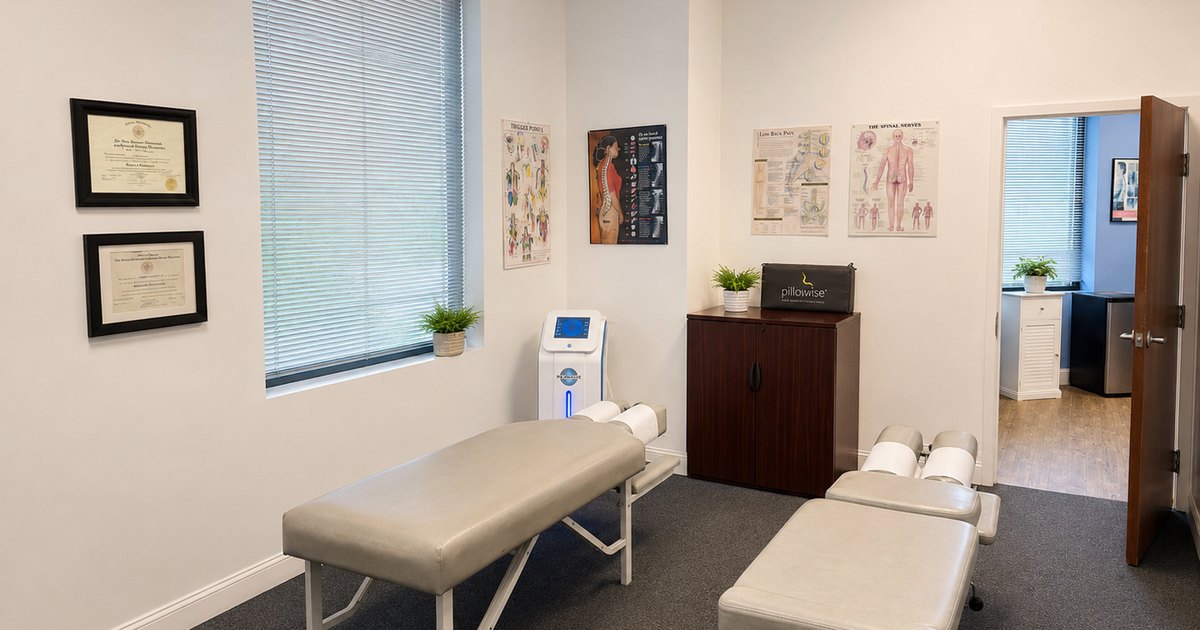
At your first visit, Dr. Curran takes a history and examines the ankle, calf, and foot to determine where the problem is — mid-portion, insertional, or something else entirely. We also look at how you move, because a stiff ankle or a hip that doesn't do its share can keep sending extra load to the tendon.
If PulseWave makes sense for you, a session typically looks like this:
- Positioning: You lie face down with the foot supported.
- Locating the tender area: We find the most sensitive spots along the tendon and apply a coupling gel.
- The treatment itself: The handpiece delivers rapid acoustic pulses. It feels like a strong, deep tapping. Over the most tender area it can be briefly uncomfortable; we adjust intensity as we go.
- Time: The PulseWave portion usually takes only minutes.
- Afterward: Most people walk out and go about their day. We'll give you guidance on activity and your home exercise program.
PulseWave is generally delivered as a short series of sessions spaced about a week apart. Changes, when they occur, tend to be gradual across the series and can continue in the weeks afterward.
Who may not be a candidate
Shock wave therapy is not appropriate for everyone. Please let us know if you:
- Are pregnant
- Take blood thinners or have a bleeding or clotting disorder
- Have an active infection, open wound, or skin condition over the area
- Have a tumor in or near the treatment area
- Have had a recent steroid injection in the area
- Have nerve or circulatory problems in the lower leg
- Suspect a full or partial tendon tear
We'll review your health history before recommending anything, and we'll refer you out when that's the right call.
Frequently asked questions
Does PulseWave hurt?
It can be uncomfortable over the most tender spots — most people describe a strong, deep tapping. It's short, and we adjust intensity throughout the session. Most patients find it very manageable.
How many sessions will I need?
It depends on how long you've had symptoms, whether the pain is mid-portion or insertional, and how you respond. PulseWave is typically delivered as a short series about a week apart. You'll get an honest estimate after your exam.
Can I keep running or working out?
Usually, with modifications. Complete rest rarely rebuilds a tendon. We'll help you adjust volume and intensity and find alternatives that keep you active while the tendon adapts.
Should I stretch my Achilles?
Gentle calf stretching is often helpful. For insertional pain, aggressive stretching and heel drops off a step can aggravate the attachment, so we tailor the program to your type of Achilles pain.
Is PulseWave the same as ultrasound therapy?
No. Therapeutic ultrasound uses high-frequency sound mainly for gentle heating. PulseWave delivers higher-energy acoustic pressure waves designed to stimulate a tissue response. They're different tools.
Is it covered by insurance?
Shock wave therapy is generally not a covered benefit. We'll walk you through what's involved before you commit, and financing options are available.
Do I need a referral?
No. You can contact our Edgewater office directly to schedule an evaluation.
What if my pain is on the bottom of my heel instead?
Pain under the heel is more often plantar fasciitis, a related but different problem. I've covered it in a separate post on PulseWave for plantar fasciitis.
The bottom line
If your Achilles started bothering you a couple of weeks ago, start with the basics: dial back the aggravating activity, check your shoes, and begin gentle calf work. Many people improve with that alone.
If it's been months, the morning stiffness keeps coming back, and you've already done the sensible things, you may be in the situation shock wave therapy is designed for — a tendon whose repair process has stalled. Combined with a progressive loading program and hands-on care, PulseWave may support the body's natural healing response and is a non-surgical option worth understanding. The research is encouraging for mid-portion Achilles pain and still developing for insertional pain, and we'll be upfront about which one you have.
Achilles pain care in Edgewater and Anne Arundel County
Maryland Chiropractic & Physical Medicine sees patients from across Anne Arundel County, including Edgewater, Annapolis, Davidsonville, Riva, Mayo, Crownsville, Severna Park, and Arnold. Learn more about the conditions we care for, our full range of services including chiropractic, massage therapy, and cupping, and Dr. Curran and our team.
We're at 137 Mitchell's Chance Road, Suite 100, Edgewater, MD 21037. Call (443) 294-6873, book a PulseWave consultation, or send us a message.
Office hours: Monday & Thursday 8:30–12:30 and 2:30–6:30 · Tuesday 8:30–12 and 2–4 · Wednesday 8:30–2 · Friday 8:30–2:30
This article is for educational purposes only and is not medical advice. Individual results may vary. Shock wave therapy is not appropriate for every patient or every cause of heel or Achilles pain, and no outcome is guaranteed. If you suspect an Achilles tendon rupture, seek prompt medical attention. Talk with a qualified healthcare provider about your specific condition before beginning any new treatment.