Plantar fasciitis has a signature that patients describe almost word for word, no matter who they are.
It's those first steps. You swing your legs out of bed, put weight on that heel, and something stabs. You limp to the bathroom. After a few minutes of moving it eases off, and by mid-morning you've half forgotten about it — until you stand up after sitting at your desk for an hour and it does the exact same thing again.
Then it goes on like that for months.
Most people arriving at our Edgewater office with heel pain have already been through the standard list: stretching, rolling a frozen bottle under the arch, new shoes, over-the-counter inserts, an anti-inflammatory or two, maybe a night splint. Some of that helped a little. None of it finished the job.
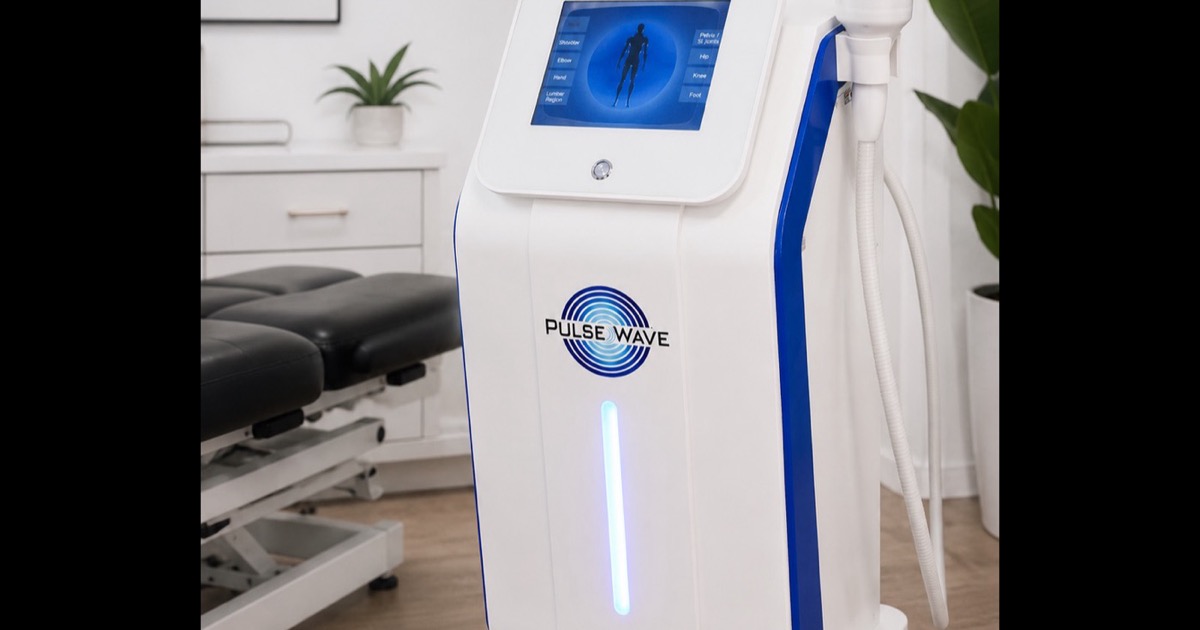
When that's the situation, shock wave therapy — which we offer here as PulseWave — is worth understanding. Not as a miracle, and not as the first thing anyone should try, but as a genuinely useful option for the stubborn cases that conservative care alone hasn't resolved.
First: what plantar fasciitis actually is
The plantar fascia is a thick band of connective tissue running along the sole of your foot, from the heel bone forward to the base of the toes. It supports the arch and takes enormous cumulative load every day.
The word "fasciitis" implies inflammation, and for a long time that's how it was framed. The current understanding is that in persistent cases, the dominant problem is less acute inflammation and more a degenerative change in the tissue — a disorganized, poorly healing area at the point where the fascia attaches to the heel. That's why it's sometimes now called plantar fasciosis.
That distinction isn't academic. It explains something patients find genuinely confusing: why anti-inflammatories keep letting them down. If the tissue's primary problem is stalled, disorganized healing rather than active inflammation, then a drug aimed at inflammation is aimed at the wrong target. It manages the symptom without moving the underlying tissue anywhere.
It also explains the morning pattern. Overnight, the fascia shortens while you sleep. That first weight-bearing step stretches the compromised tissue abruptly — hence the stab. Movement warms and lengthens it, so it settles. Sit still long enough and you reset the whole cycle.
The American Academy of Orthopaedic Surgeons has a solid plain-English overview of the condition if you want more background.
Where shock wave therapy fits
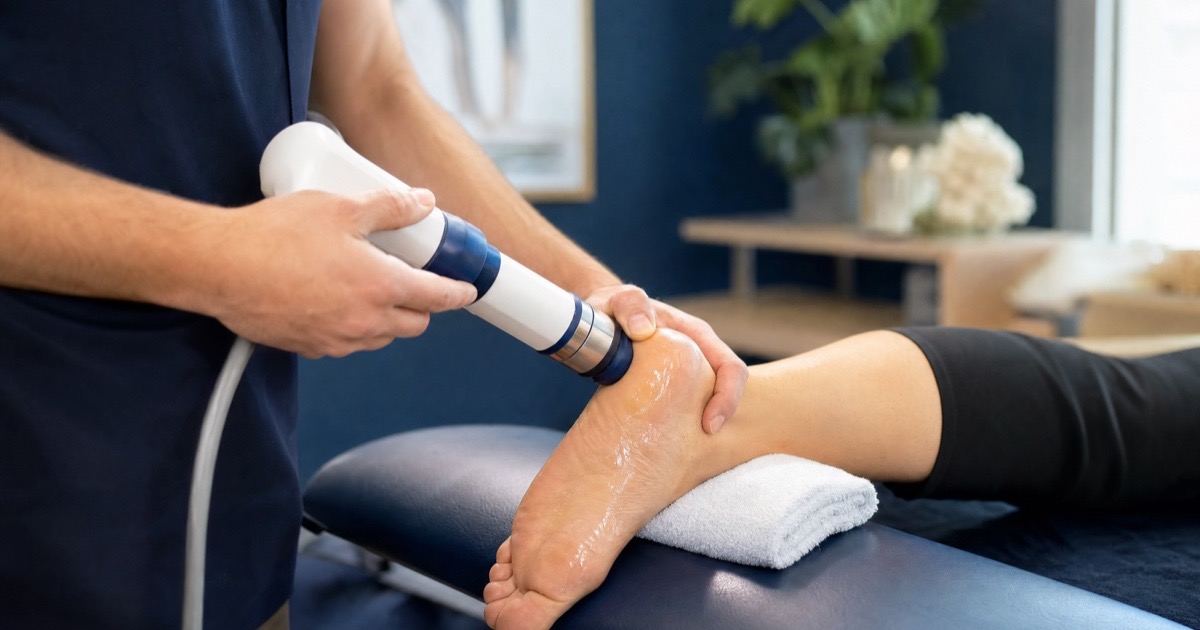
Shock wave therapy — clinically, extracorporeal shockwave therapy or ESWT — delivers focused acoustic pressure waves into tissue through the skin. No incision, no needle, no medication.
The mechanism is essentially the opposite of a painkiller. Rather than quieting the area, the acoustic energy is designed to stimulate it: increasing local circulation and prompting the body's own repair response in tissue that has settled into a stalled, chronic state.
For a condition whose core problem is stalled healing, that's a logical fit — which is why plantar fasciitis is one of the most extensively studied applications of the technology. You can browse the published research on shock wave therapy for plantar fasciitis on PubMed.
I want to be measured here. Shock wave therapy is not a guarantee, results vary between individuals, and it isn't the right starting point for heel pain that began three weeks ago. Its place is specifically the chronic case — the one that's been going for months and hasn't responded adequately to conservative care. That's the situation where it earns its keep.
What a PulseWave session is actually like
Patients are usually braced for something worse than it is, largely because "shock wave" sounds alarming. It isn't electrical, and it has nothing to do with electric shock. Here's the reality.
Before. We examine the foot, confirm where the pain actually originates, and check the things that commonly drive it — ankle mobility, calf tightness, arch mechanics, gait, and what you stand on all day. Heel pain isn't always plantar fasciitis, and treating the wrong thing well is still treating the wrong thing.
During. You lie on the treatment table with the foot exposed. We apply a gel to couple the handpiece to the skin, then work over the heel and arch. You'll feel a rapid tapping or thudding, and over the tender spot itself it can be briefly uncomfortable — a strong, deep sensation rather than a sharp pain. We adjust intensity to what you can tolerate; it should never be something you have to grit your teeth through. The treatment portion typically runs about five to ten minutes.
After. You walk out normally. Some people notice mild soreness or a slightly tender heel for a day or so, similar to post-exercise ache. There's no boot, no crutches, no time off. We usually ask you to avoid high-impact activity for around 24–48 hours afterward and to keep up whatever stretching and loading work we've assigned.
How many. Shock wave therapy is delivered as a series, typically spaced about a week apart, not as a single visit. Changes tend to be gradual and often continue after the series finishes, since what's being stimulated is a healing response, not a numbing effect. We'll give you a realistic estimate for your case after examining you.
What it won't do on its own
This is the part I'd want to hear if I were the patient.
Shock wave therapy addresses the tissue. It does not address why the tissue got overloaded in the first place — and in plantar fasciitis, there is almost always a why: calf and Achilles tightness pulling on the heel, restricted ankle motion, weak foot intrinsic muscles, a sudden jump in activity or mileage, a change in footwear, or eight hours a day standing on a hard floor.
If those persist unchanged, you're treating tissue that will simply get reloaded the same way. That's why we pair PulseWave with hands-on care, a specific calf and fascia loading program, and honest attention to footwear and daily standing habits. The combination is what tends to hold; the device alone is a partial answer.
It's also why I'd rather turn away a patient who wants shock wave and nothing else than take their money for half a plan.
Frequently asked questions
Does PulseWave hurt?
Over the tender area it can be briefly uncomfortable — a deep, strong tapping sensation. Most patients describe it as very manageable, and we adjust intensity to your tolerance throughout. It's typically much less unpleasant than people expect.
How many sessions will I need?
It's delivered as a series spaced roughly a week apart. The exact number depends on how long you've had the problem and how you respond. We'll give you a straight estimate after examining you rather than a number from a brochure.
How soon might I notice a change?
Usually gradually across the series rather than immediately, and improvement often continues after the last session. Individual results vary.
Is there any downtime?
No. You walk out and resume your day. We ask you to skip high-impact activity for about 24–48 hours after each session.
Do I need a referral?
No. You can contact our Edgewater office directly.
Who shouldn't have it?
Shock wave therapy isn't appropriate for everyone. We'd need to know if you're pregnant, taking blood thinners or have a clotting disorder, have an active infection or open wound in the area, have a tumor in the treatment area, or have a nerve or circulatory condition affecting the foot. Bring your history to the consultation and we'll tell you honestly if it's not a fit.
Is heel pain always plantar fasciitis?
No — and this matters. Heel pain can also come from a stress fracture, nerve entrapment, fat pad atrophy, Achilles problems, or referred pain from the low back. That's exactly why we examine before we treat.
The bottom line
If your heel pain is weeks old, start with the basics — calf and fascia stretching, sensible footwear, load management. Most people get better on that alone.
If it's been going for months, you've done the basics diligently, and those first steps out of bed still stop you short, then you're in the situation shock wave therapy was designed for: tissue that has stalled rather than tissue that is acutely inflamed. Combined with hands-on care and a real loading program, it's one of the better non-surgical options available for a chronic case.
If you're new to the technology, I've written a fuller explainer on what PulseWave shock wave therapy is and how it works. You can also read about the conditions we treat and our full services.
To have your heel evaluated, we're at 137 Mitchell's Chance Road, Suite 100, Edgewater, MD 21037. Call (443) 294-6873, book a PulseWave consultation, or get in touch here. If cost is a consideration, see our financing options.
This article is for educational purposes and is not medical advice. Individual results may vary. Shock wave therapy is not appropriate for every patient or every cause of heel pain. Talk with a qualified healthcare provider about your specific condition before beginning any new treatment.