Almost nobody who walks into our Edgewater, MD office with tennis elbow got it from playing tennis.
They got it from a summer of pressure-washing the deck. From hanging drywall. From a job that involves a screwdriver eight hours a day, or a mouse and keyboard eight hours a day, or hauling crab pots off a boat in the Chesapeake. One patient traced hers to a single weekend of repainting a kitchen.
The label is misleading, and so is a lot of what people are told about how to handle it. So let me walk through what lateral epicondylitis actually is, why so many cases drag on for a year or more, and where PulseWave shock wave therapy does and does not belong in the picture.
What tennis elbow actually is
The muscles that lift your wrist and fingers upward — the wrist extensors — all converge into a common tendon that anchors onto the bony bump on the outside of your elbow. That bump is the lateral epicondyle. One muscle in particular, the extensor carpi radialis brevis, takes the brunt of the load.
Every time you grip something, that tendon loads. Grip and twist at the same time, and it loads harder. Do that thousands of times over weeks and the tendon can't keep up with the repair demand.
Here's the part that changes how you should think about treatment: despite the "-itis" ending, chronic tennis elbow is not primarily an inflammatory problem. When researchers have examined this tissue under a microscope, what they find is disorganized collagen, an overgrowth of small blood vessels, abundant fibroblasts, and microscopic tearing — with a conspicuous absence of the inflammatory cells you'd expect if it were classic inflammation. The National Library of Medicine's clinical reference on lateral epicondylitis describes it as a degenerative overuse process, which is why many clinicians now prefer the term tendinosis.
That distinction is not academic. It explains why a bottle of ibuprofen and two weeks of rest so often does nothing for the six-month case. You can't anti-inflammatory your way out of a problem that isn't inflamed. The tissue needs a repair signal, not a suppression signal.
Why it drags on
Tendon is stubborn tissue. It has a poor blood supply compared with muscle, which means the raw materials for repair arrive slowly. And because the elbow is involved in nearly everything you do with your hands, complete rest is essentially impossible outside of a sling you won't wear.
The reference literature puts the natural course at 1 to 2 years for the majority of cases to resolve on their own. Most people don't want to hear "give it eighteen months," particularly when their income depends on their hands.
How PulseWave fits
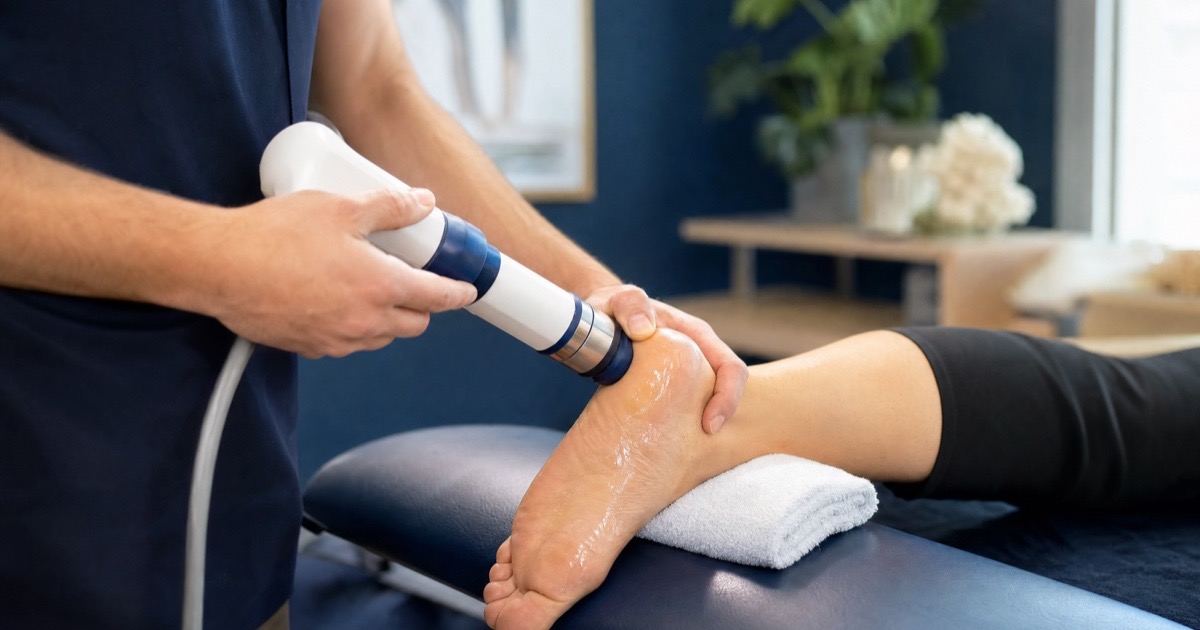
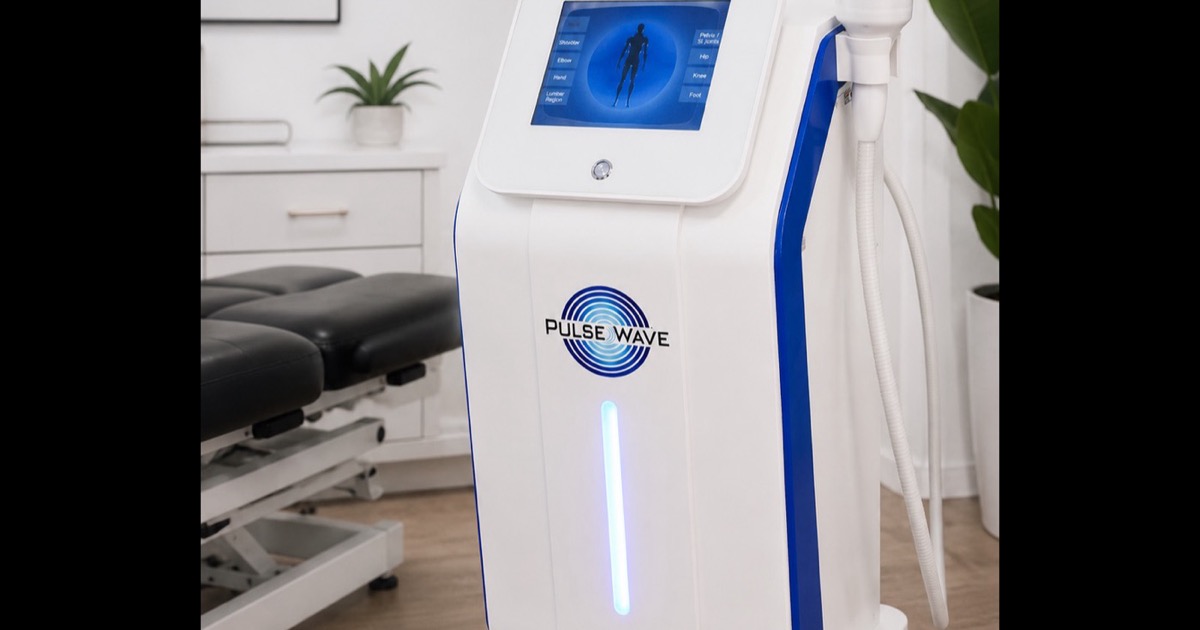
PulseWave is our shock wave system — a device that delivers focused acoustic waves into a targeted area of tissue through a handpiece pressed against the skin. It's non-invasive. There's no incision, no injection, and no anesthesia.
The underlying idea is mechanotransduction: cells respond to mechanical signals. Acoustic energy delivered into a stalled, degenerated tendon is designed to stimulate local cellular activity and blood-vessel formation, and to support the body's natural healing response in tissue that has gone quiet. Rather than numbing the area, the approach is meant to prompt the tissue to restart a repair process it abandoned.
If you want the full mechanism in plain language, I've written a longer explainer on what PulseWave shock wave therapy is and how it works.
What the research actually says
I'd rather give you the real picture than a marketing version, because the evidence here is genuinely mixed and you should know that before you decide.
On the favorable side, a 2020 systematic review and meta-analysis pooling 13 trials and 1,035 patients found that pain scores and grip strength were significantly better in the shock wave groups compared with several alternative treatments, with a favorable safety profile. The authors were candid that the quality and quantity of the underlying studies limited how firmly they could conclude anything.
On the skeptical side, a 2021 systematic review in lateral elbow tendinopathy found low-to-moderate certainty evidence of no clear clinical benefit for shock wave therapy compared with sham treatment or corticosteroid injection — though it did outperform ultrasound and laser therapy.
So: not a settled question. Shock wave therapy for tennis elbow is a reasonable option with a real mechanism, a good safety record, and evidence that points in different directions depending on which comparison you run. Anyone who tells you it is a guaranteed answer for elbow pain is overselling it. Individual results may vary, and I say that to every patient before we begin.
What I can tell you is where it makes the most sense: chronic cases, past the three-month mark, in patients who have already done honest conservative care and are weighing more invasive options. That's the window.
What a session is actually like
Patients build this up in their heads more than they need to.
You sit down. We locate the exact tender point on the outside of the elbow — usually a spot the size of a dime, sometimes an inch or so below the bony bump. Gel goes on. The handpiece is placed against the skin and delivers rapid pulses.
The sensation is a deep, firm tapping. Over the sorest spot it can be briefly uncomfortable, and that's expected — we adjust intensity to your tolerance as we go, not to a preset number. Treatment time over an elbow is short, generally a handful of minutes of actual application.
Afterward you get up and go back to your day. There's no downtime and no bandage. We do ask you to avoid heavy gripping and loaded wrist work for about 24 to 48 hours afterward, and to skip ice and anti-inflammatory medication in that window if you reasonably can — the whole point is to let the response we just prompted run its course.
Sessions are spaced roughly a week apart in a short series. How many you need depends on how long you've had it and how you're responding; we'll give you a straight estimate after examining you, not a number off a brochure.
The part most clinics skip
Here's where I'll be blunt.
Shock wave therapy addresses the tendon. It does not address why that tendon got overloaded — and with tennis elbow there is always a why.
It might be a grip that's stronger than the shoulder and scapular muscles supporting it. It might be restricted motion in the neck or mid-back changing how the arm loads. It might be a wrist that lost extension range after an old injury. It might be a tool grip that's too small, a work station set up wrong, or a sudden jump in volume — the three-day painting project, the deck rebuild, the new gym program.
If that cause is unchanged, you are treating tissue that will simply get reloaded the same way the moment you feel better.
That's why we pair PulseWave with hands-on care of the elbow, wrist, and shoulder girdle, a progressive eccentric loading program for the extensor tendon, and a plain conversation about your work and hobbies. Eccentric loading in particular has a solid track record in tendon rehabilitation and is not optional in my book — the device may open a window, but loading is what rebuilds capacity.
The combination is what tends to hold. The device alone is a partial answer, and I'd rather tell you that now than after a series.
Is it appropriate for you?
Reasonable candidates are typically people who:
- Have had lateral elbow pain for more than three months
- Have already tried rest, activity modification, a counterforce strap, and some form of therapy
- Have pain that reproduces with resisted wrist extension or gripping
- Want to avoid or delay injections or surgery
- Can commit to a series plus a home loading program
Shock wave therapy is not appropriate for everyone. We need to know if you are pregnant, taking blood thinners or living with a clotting disorder, have an active infection or open wound over the area, have a tumor in the treatment region, or have a nerve or circulatory condition affecting the arm. Bring your history and we'll tell you honestly if it isn't a fit.
And one more thing worth saying clearly: not all outer-elbow pain is tennis elbow. Radial tunnel syndrome can mimic it closely and coexists in a meaningful share of cases. Pain can also refer from the neck. There's joint arthritis, there's bursitis, there are stress reactions. If numbness, tingling, or radiating symptoms are part of your picture, that changes the diagnosis and therefore the plan. This is exactly why we examine before we treat rather than pointing a device at whatever hurts.
Frequently asked questions
Does PulseWave hurt?
Over the tender spot it can be briefly uncomfortable — a deep, strong tapping. Most patients find it very manageable and report it was less unpleasant than they anticipated. We adjust intensity throughout.
How many sessions will I need?
It's delivered as a short series, roughly a week apart. The number depends on how chronic the problem is and how you respond. You'll get an honest estimate after your exam.
How soon might I notice a change?
Typically gradually across the series rather than after the first visit, and improvement often continues for weeks after the final session. Individual results may vary.
Can I keep working?
In most cases yes. We'll talk through modifications — grip size, tool changes, taking the twist out of repetitive tasks — rather than telling you to stop using your arm entirely, which is rarely realistic.
Is it covered by insurance?
Shock wave therapy is generally not a covered benefit. We'll be upfront about what's involved before you commit to anything, and there are financing options if that's helpful.
Do I need a referral?
No. You can contact our Edgewater office directly to be evaluated.
What if it's my inner elbow that hurts?
Pain on the inside of the elbow is medial epicondylitis — golfer's elbow. It's a related overuse tendinopathy of the wrist flexors, and the assessment approach is similar. Mention it when you call and we'll examine accordingly.
The bottom line
If your elbow started hurting three weeks ago, start conservatively: back off the aggravating task, adjust your grip and tools, try a counterforce strap, and begin gentle loading. A lot of people get better on that alone.
If it's been months, you've done the sensible things, and picking up a coffee cup still makes you wince, then you're in the situation shock wave therapy was designed for — tissue that has stalled rather than tissue that is acutely inflamed. Paired with hands-on care and a real loading program, it's a reasonable non-surgical option worth understanding, with the honest caveat that the research is still mixed.
We see patients from across Anne Arundel County — Edgewater, Annapolis, Davidsonville, Riva, Mayo, Crownsville, Severna Park, and Arnold. You can read more about the conditions we care for, our full range of services including massage therapy and cupping, the PulseWave program itself, and Dr. Curran and the practice.
To have your elbow evaluated, we're at 137 Mitchell's Chance Road, Suite 100, Edgewater, MD 21037. Call (443) 294-6873, book a PulseWave consultation, or get in touch here.
This article is for educational purposes and is not medical advice. Individual results may vary. Shock wave therapy is not appropriate for every patient or every cause of elbow pain, and no outcome is guaranteed. Talk with a qualified healthcare provider about your specific condition before beginning any new treatment.