The patients who come into our Edgewater, MD office with neck pain almost never hurt themselves doing anything dramatic. No car accident, no fall, no weekend warrior injury. They tell me some version of the same story: "I don't know what I did. It just started."
Then I ask what their day looks like. Eight hours on a laptop. A commute up Route 2 toward Annapolis with the phone in a cupholder. Evenings scrolling on the couch. A Saturday spent catching up on email because the week got away from them.
Nothing happened. That's the point. Nothing happened four hundred times, and the fourth hundred and first time their neck finally said something about it.
This is what people now call tech neck — and it has quietly become one of the most common reasons adults across Anne Arundel County end up in a chiropractor's office. Here's what it actually is, why the standard advice ("sit up straight!") so often falls flat, and what a realistic plan looks like.
What tech neck actually is
Your head weighs roughly 10 to 12 pounds. Balanced directly over your shoulders, your spine handles that load efficiently — the bones stack, the ligaments do most of the holding, and your muscles barely have to work.
Tip that head forward to look at a screen, and the math changes fast. Because your head is now out in front of the axis it's supposed to sit on, it becomes a lever arm. A commonly cited figure in the clinical literature is that the effective load on the cervical spine climbs by roughly 10 pounds for every inch the head drifts forward. Whether the precise number holds in every posture is debatable, but the direction is not: the further forward your head goes, the harder the muscles at the back of your neck have to pull just to keep your eyes level.
That sustained pull is the injury. Not a tear, not a rupture — a slow accumulation of load on tissue that was never designed to hold a static contraction for hours at a stretch.
The clinical name for the underlying posture is forward head posture, and researchers have described the pattern fairly consistently: the deep flexor muscles at the front of the neck weaken, the mid-back muscles that pull the shoulder blades together weaken, and the muscles along the back of the neck and across the chest shorten and stay short. A 2022 review in Acta Medica Academica described text neck syndrome as a genuine public health issue tied to the way we use phones and computers, with effects that reach beyond the neck into sleep, mood, and quality of life.
Why it doesn't feel like a neck problem
Here's what surprises people: a lot of tech neck doesn't announce itself as neck pain.
It shows up as a headache that starts at the base of the skull and creeps up behind one eye by mid-afternoon. It shows up as burning between the shoulder blades. As a shoulder that clicks. As numbness or tingling down an arm that gets blamed on a pinched nerve or carpal tunnel. As jaw tightness. As waking up at 3 a.m. and never finding a comfortable position for the pillow.
The headache connection is worth dwelling on, because it's so often missed. Headaches that originate from irritated structures in the upper neck have their own diagnostic category — cervicogenic headache — and they're routinely mistaken for tension headaches or low-grade migraines. When the source is the neck, treating the head is chasing the wrong end of the problem.
Why "just fix your posture" doesn't work
Every patient with tech neck has already been told to sit up straight. Many of them have bought a standing desk. Some have tried one of those posture-corrector braces from Amazon. And they're still here, in my office, still hurting.
Three reasons that advice underperforms:
1. Posture is a strength problem disguised as a habit problem. You cannot hold a position your muscles aren't conditioned to hold. Telling someone with weak deep neck flexors to keep their head back is like telling someone to hold a plank for eight hours. They'll manage ninety seconds, drift back, and conclude they have no discipline. They have a capacity problem, not a character problem.
2. The best posture is the next one. Research on office ergonomics keeps landing on the same uncomfortable finding: a perfectly designed workstation still produces discomfort if you hold one position all day. Static loading is the enemy. A "bad" posture you change every twenty minutes is easier on tissue than a textbook posture you freeze in for four hours.
3. By the time it hurts, the joints are usually involved too. Weeks or months of that sustained load doesn't just fatigue muscles — it changes how the individual segments of the neck and upper back move. Some become stiff and guarded. Others start taking up the slack and become irritated from overwork. Stretching a stiff joint that has quietly stopped gliding doesn't accomplish much, which is why so many people report that their stretching routine feels good for about four minutes.
What we actually do about it
I want to be careful here, because this is an area where a lot of overclaiming happens. Nothing described below is a cure, and nobody can promise you an outcome. What I can describe is the reasoning behind how we approach it at our office at 137 Mitchell's Chance Road, Suite 100, and what's reasonable to expect.
Finding out which parts are actually stuck
The first visit is mostly assessment, not treatment. We want to know which segments of your cervical and thoracic spine have lost normal motion, which muscles have gone weak versus which have gone protective, whether the shoulder blade is tracking properly, and — importantly — whether anything in your history suggests this isn't a mechanical problem at all. Neck pain with certain red-flag features belongs with a medical physician, not a chiropractor, and part of my job is knowing the difference.
Restoring motion to the segments that lost it
Chiropractic adjustment is a manual, targeted input applied to a joint that isn't moving well, intended to restore normal motion at that segment. For the upper neck and mid-back, that often means a combination of specific adjusting and lower-force mobilization, depending on what the tissue tolerates and what the patient prefers.
The evidence base here is real but modest, and I'd rather tell you that than oversell it. A systematic review and meta-analysis published in the European Journal of Pain examining spinal manipulation specifically for cervicogenic headache found small but statistically significant short-term improvements in pain intensity, headache frequency, and disability compared with other manual therapies — while noting plainly that high-quality evidence in this area is still limited and the long-term effects were not significant.
Small short-term benefits, honestly reported. That's not nothing, and it's not a miracle. Individual results may vary.
Soft tissue work for what's guarding
Massage therapy and cupping both have a role when the surrounding musculature has been braced for months. These are designed to reduce protective tension and improve tissue mobility so that adjustments hold better and exercise is tolerable. You'll find more on both under our services.
Where PulseWave fits — and where it doesn't
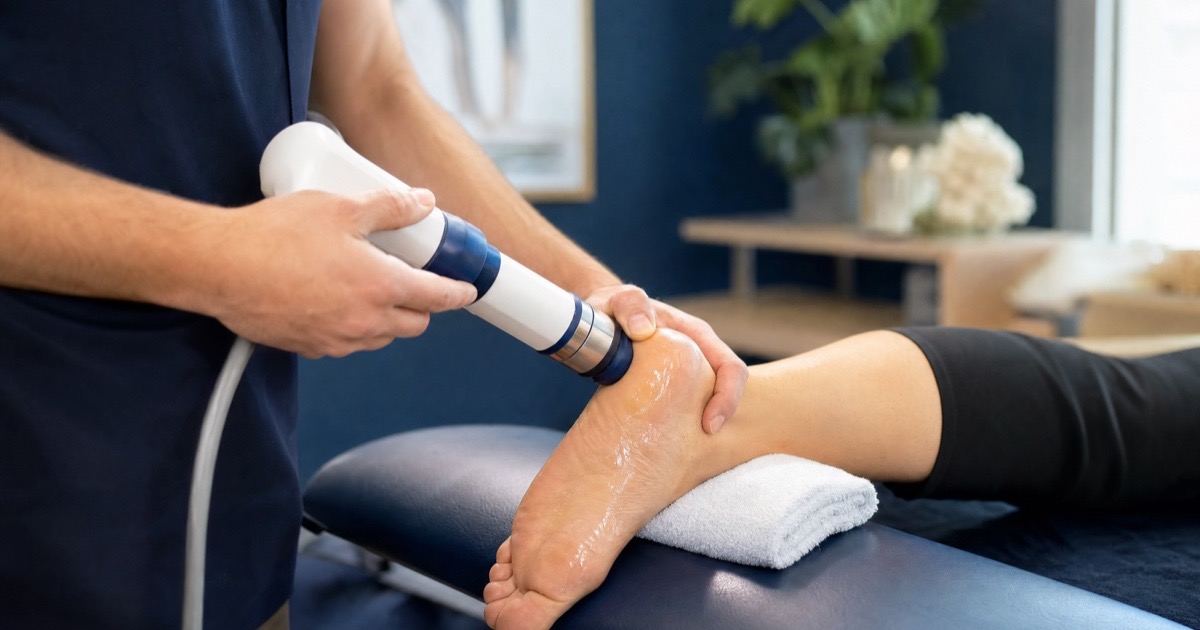
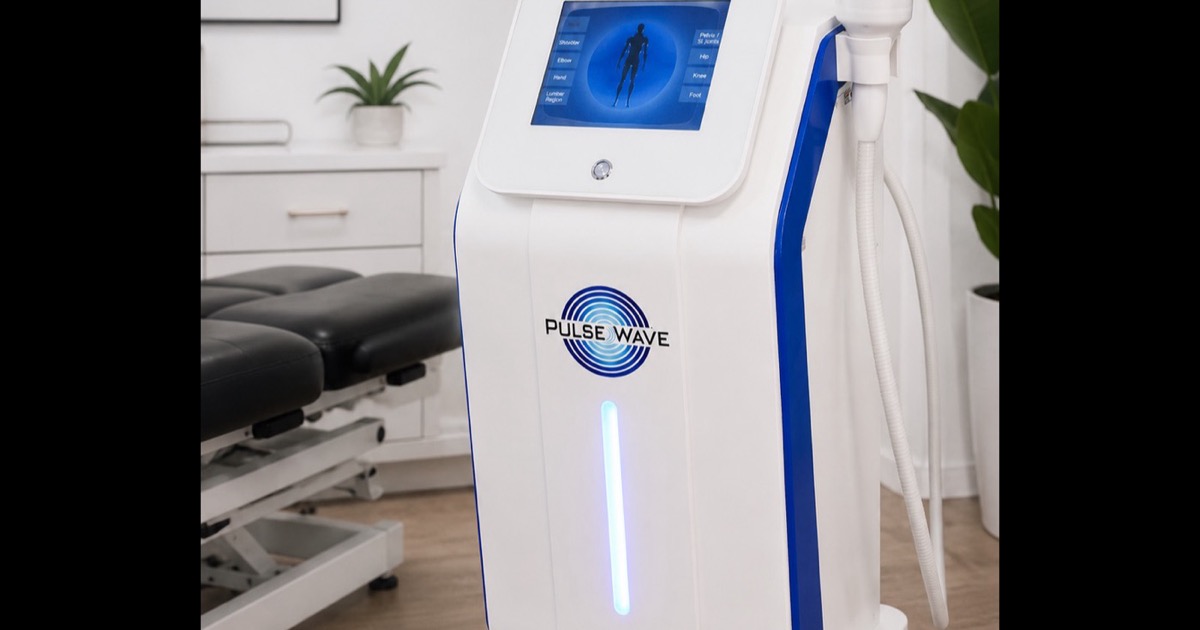
Some patients ask about PulseWave shock wave therapy for neck and shoulder complaints. PulseWave delivers focused acoustic waves into targeted tissue and is designed to support the body's natural healing response in stubborn tendon and soft-tissue problems that haven't improved with conservative care.
For a straightforward mechanical neck problem in its first few weeks, it's usually not the first tool I reach for. Where it becomes a reasonable conversation is a chronic shoulder or upper-back tendon issue riding alongside the neck complaint that hasn't budged in months. It may support recovery in the right case. It isn't a posture fix, and it isn't a substitute for the strengthening work described below.
The part that determines whether it lasts
Everything above buys you a window. What you do in that window decides whether you're back in six months.
That means loading the muscles that gave out. A systematic review and meta-analysis of exercise for office workers with neck pain, published in the South African Journal of Physiotherapy, found that strengthening exercise produced a clinically meaningful improvement in neck pain compared with no exercise — with the evidence for endurance and stretching work considerably thinner. If you take one thing from this article, take that one: strengthen, don't just stretch.
In practice that's deep neck flexor work, scapular retraction and lower-trapezius strengthening, and thoracic extension mobility. Ten focused minutes most days beats an hour on Sunday. We'll show you the specific versions that match what we found in your assessment.
Small changes that punch above their weight
While you're working through care, these are the adjustments that patients report actually make a difference:
- Raise the screen. The top of the monitor should sit at or just below eye level. A laptop on a desk guarantees a forward head posture — a $15 stand and a separate keyboard solve more neck pain than most gadgets on the market.
- Move the phone, not the head. Bring the phone up toward your face instead of dropping your chin to meet it. Feels awkward for three days, then it doesn't.
- Set a 30-minute timer. Stand, roll the shoulders back, look at something far away for twenty seconds. The goal is interrupting static load, not achieving perfect form.
- Check the pillow. A pillow that's too tall props your head into the same flexed position you spent all day in. You want the neck supported in neutral, not folded.
- Watch the second screen. Dual monitors tend to produce more rotated, asymmetric head positions than a single centered screen. If one side of your neck always hurts, look at which way your desk makes you turn.
- Get the bag off one shoulder. A heavy laptop bag on the same side every day is eight hours of asymmetric load you didn't account for.
Frequently asked questions
Is tech neck permanent?
Postural patterns are generally modifiable, particularly when the underlying strength and mobility deficits are addressed. Long-standing cases with established joint degeneration may be less responsive than recent ones, which is a reasonable argument for not waiting a year to look at it. Individual results may vary.
How long before I feel different?
Most patients with a mechanical neck complaint notice some change within the first few visits, though "notice some change" is not the same as "resolved." Building the strength that keeps it away takes longer — think weeks, not days. We'd rather set that expectation honestly up front than have you feel misled at visit six.
Does the adjustment hurt?
Most people describe it as a brief pressure followed by a sense of release. Some feel mild soreness for a day afterward, similar to post-workout soreness. If you'd rather avoid the traditional "crack," say so — there are lower-force instrument and mobilization approaches that we use routinely, and plenty of patients prefer them.
I'm in my twenties. Am I too young for this to be a real problem?
Unfortunately, no. Forward head posture is documented at high rates among students and young adults specifically because of device use. Younger tissue is more forgiving, which usually means a better response — but it also means symptoms get dismissed for years before anyone looks at them.
Do I need X-rays?
Not automatically. Imaging is appropriate when the history or examination raises a specific question that imaging would answer. We'll discuss it if it's indicated rather than defaulting to it.
Do you take my insurance?
We work with a range of plans and also offer self-pay options. The financing page covers the details, or you can call the office and we'll check your specific coverage before you commit to anything.
Where are you located?
We're at 137 Mitchell's Chance Road, Suite 100, Edgewater, MD 21037 — just over the South River bridge from Annapolis, and an easy drive from Davidsonville, Riva, Mayo, Crownsville, Severna Park, and Arnold. Phone: (443) 294-6873.
Office hours are Monday and Thursday 8:30–12:30 and 2:30–6:30, Tuesday 8:30–12 and 2–4, Wednesday 8:30–2, and Friday 8:30–2:30.
When to get it looked at
If your neck has been bothering you for more than a few weeks, if headaches are becoming a regular feature of your afternoons, or if you're getting any numbness or tingling into an arm, it's worth having someone assess it properly rather than continuing to troubleshoot it yourself with YouTube stretches.
You can see the full range of what we address on our conditions page, read more about the practice, or get in touch here. If you'd like to talk through whether PulseWave makes sense for a stubborn related issue, we can cover that at the same visit.
This article is provided for general educational purposes only and does not constitute medical advice, diagnosis, or treatment. It is not a substitute for an evaluation by a qualified healthcare provider. Chiropractic care and the therapies described above are not represented as cures for any condition, and individual results may vary. If you are experiencing severe, worsening, or unexplained symptoms — including neck pain following trauma, progressive weakness, or loss of coordination — seek prompt medical attention.