If you live in Edgewater, Riva, or anywhere along the South River, you probably know someone who has quietly stopped doing something because of their knees. The morning walk by the water. The stairs at the marina. The weekend softball league, or just getting down on the floor to play with the grandkids.
Knee pain is one of the most common reasons people walk into our office at 137 Mitchell's Chance Road in Edgewater, MD, and it is also one of the most misunderstood. "Knee pain" is not one problem. It is a label that covers worn cartilage, irritated tendons, sprained ligaments, tight muscles, and sometimes trouble that starts in the hip or foot.
So when people ask whether PulseWave shock wave therapy can help with knee pain, the honest answer starts with a question of our own: which part of the knee is the problem? Let's walk through what the research says, where it is strong, where it is still thin, and how we think about it at Maryland Chiropractic & Physical Medicine.
What PulseWave actually does
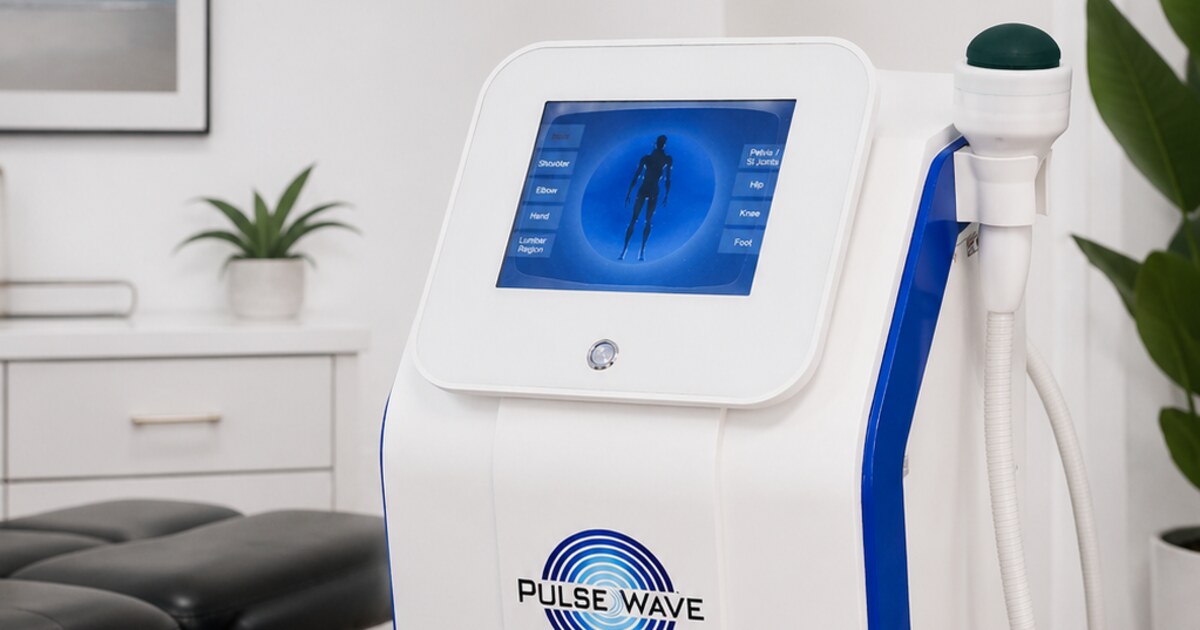
PulseWave is a form of extracorporeal shock wave therapy, often shortened to ESWT. A handheld applicator delivers focused acoustic waves into the tissue beneath the skin. These are mechanical pulses of sound energy, not electricity, not heat, and not a drug.
The working theory is that these pulses are designed to stimulate the body's natural healing response in the treated area. Researchers have proposed several mechanisms, including increased local blood flow, cellular signaling that may support tissue repair, and changes in how nearby nerves carry pain signals. These ideas are still being studied, and no one should tell you the exact mechanism is settled.
What is practical for a patient: it is non-invasive, there is no needle and no incision, and sessions are short. You can read the broader overview on our PulseWave page.
Knee pain is not one thing
Before asking whether shock waves help, it is worth knowing what is being treated. The most common knee complaints we see among patients from Edgewater, Annapolis, Davidsonville, and Crownsville fall into a few buckets.
Tendon-related knee pain
The patellar tendon connects your kneecap to your shinbone. When it is overloaded, you get pain just below the kneecap, often called patellar tendinopathy or "jumper's knee." It shows up in runners, basketball and soccer players, and also in people whose jobs have them climbing ladders or kneeling all day. The quadriceps tendon above the kneecap and the hamstring and IT band attachments around the knee can behave similarly.
Tendon problems are where shock wave therapy has the longest research history, because ESWT was studied for tendon conditions in other parts of the body, such as the heel, elbow, and shoulder, before it was studied at the knee. If you have read our posts on plantar fasciitis or tennis elbow, the logic is the same.
Joint-related knee pain (osteoarthritis)
Knee osteoarthritis is the gradual wearing of the cartilage that cushions the joint. It causes stiffness, aching after activity, and pain with stairs or getting out of a chair. This is a very different problem from a sore tendon, and it is one where expectations need to be realistic. Shock wave therapy cannot rebuild worn cartilage, and we do not claim that it does. The research question is narrower: may it help with pain and function in people living with knee osteoarthritis?
Muscle and movement-related knee pain
Quite a lot of knee pain traces back to the tissue around the joint rather than the joint itself: tight quadriceps, irritated pes anserine area on the inner knee, trigger points in the calf or thigh, or a hip and foot that are not sharing the load well. These problems often respond to a combination of approaches, which is why a hands-on exam matters more than any single device.
What the research says
Here is where we want to be careful, because this is a field with real studies and real limits.
Knee osteoarthritis. A systematic review and meta-regression of randomized controlled trials, titled Clinical efficacy of extracorporeal shockwave therapy for knee osteoarthritis, looked at how ESWT performed across multiple trials. Reviews like this pool small studies that used different devices, energy settings, and numbers of sessions, so the takeaway is a general direction of interest rather than a promise. The studies are not uniform, and researchers continue to debate the best dosing.
Patellar tendinopathy. A systematic review and meta-analysis, Treatment of Jumper's Knee with Extracorporeal Shockwave Therapy, examined the evidence for ESWT in this specific tendon problem. As with many treatments for tendon pain, the quality and consistency of trials varies, and some analyses have reported mixed findings. That is useful information: it tells us ESWT is an actively studied option that may suit some people, not a guaranteed answer for everyone.
What this adds up to. The evidence is promising enough that shock wave therapy is widely used and continues to be studied, and it is still not strong enough for anyone to promise a result. We would rather tell you that plainly than oversell it. Individual results may vary, and some people notice more change than others.
Who might be a good candidate
In our experience, people who tend to ask about PulseWave for the knee include:
- Long-standing tendon pain. Soreness below or above the kneecap that has lingered for months despite rest, ice, and stretching.
- Activity-limiting stiffness and aching. People with knee osteoarthritis who want an added non-invasive option alongside exercise and other care.
- Overuse patterns. Runners, cyclists, and recreational athletes whose knee pain flares with training.
- People who would rather avoid injections or surgery as a first step and want to explore conservative options.
Who we would want to evaluate carefully or refer out first: anyone with a hot, swollen, red knee, a knee that locks or gives way, a suspected fracture or ligament tear, pain after a significant fall or car accident, unexplained fever, or numbness and weakness in the leg. Those situations call for a proper exam, and sometimes imaging or a referral, before any shock wave session is considered. If the knee pain began after a collision, our personal injury care team can start with a full evaluation.
What a PulseWave knee session looks like
Your first visit is not just a machine appointment. Dr. Curran starts with your history and a hands-on exam: how you walk, how the knee bends and loads, what the hip and ankle are doing, and where exactly it hurts. That determines whether PulseWave fits your situation at all.
If it does, a typical session goes like this:
- You sit or lie comfortably with the knee exposed.
- Gel is applied and the applicator is moved over the targeted area.
- You feel rhythmic pulses. Most people describe it as tapping or pressure, and it can be a bit tender over sore spots. The intensity is adjusted to your comfort.
- The treatment itself usually takes only a few minutes, and there is generally no downtime afterward.
Some people feel soreness for a day or so afterward, similar to a deep massage. Others feel nothing unusual. We typically combine PulseWave with other care, which is the part many patients do not expect.
PulseWave works best as part of a plan
A knee rarely hurts in isolation. If the hips are stiff or weak, the knee absorbs extra stress. If the foot collapses inward, the knee twists. If the quadriceps and hamstrings are tight, the tendons around the knee get overloaded.
That is why we look at the whole chain. Depending on your exam, your plan may combine PulseWave with chiropractic care, soft tissue work, massage therapy or cupping, and a short list of exercises you can do at home. You can see the kinds of problems we work with on our conditions page.
A few simple habits help most knees regardless of treatment:
- Build strength gradually in the quadriceps, glutes, and calves.
- Swap one high-impact workout a week for cycling, swimming, or walking the flat trails around the South River.
- Wear shoes that fit and replace them when the cushioning is gone.
- Avoid long stretches of staying in one position, whether kneeling or sitting.
Questions we hear about PulseWave and the knee
Does PulseWave repair a torn meniscus or ligament?
No. Structural tears are outside what we claim PulseWave can address, and suspected tears need an exam and possibly imaging. PulseWave is studied mostly for tendon and soft tissue pain and for pain associated with osteoarthritis.
How many sessions might I need?
It depends on the condition, how long it has been present, and how your body responds. Dr. Curran will talk through a plan after your exam and reassess as you go. We do not promise a set number of visits or a set outcome.
Is it painful?
Most people find it tolerable. You may feel pressure and tenderness over the sore area, and we adjust the intensity to what you can comfortably handle.
Can I walk and drive afterward?
Yes. Most people leave the office on their own feet and go about their day, though we may suggest easing off hard activity for a short time.
Does insurance cover it?
Coverage for shock wave therapy varies widely by plan, and it is often not covered. Our team can explain what we know about your options, and you can read about payment on our financing page. If your knee pain is part of an auto accident claim, call us to talk about how that is handled.
How do I know if it is the right option?
Book an exam. We would rather tell you honestly that PulseWave is not the right fit than treat a knee that needs something else.
Knee pain care in Edgewater and Anne Arundel County
Maryland Chiropractic & Physical Medicine serves patients across Edgewater and Anne Arundel County, including Annapolis, Severna Park, Davidsonville, Riva, Crownsville, Mayo, and Arnold. Learn more about Dr. Curran and our team or see our full list of services.
Maryland Chiropractic & Physical Medicine 137 Mitchell's Chance Road, Suite 100, Edgewater, MD 21037 Phone: (443) 294-6873
Hours: Monday and Thursday 8:30 AM to 12:30 PM and 2:30 PM to 6:30 PM; Tuesday 8:30 AM to 12 PM and 2 PM to 4 PM; Wednesday 8:30 AM to 2 PM; Friday 8:30 AM to 2:30 PM.
Ready to find out whether PulseWave fits your knee? Book your visit here or contact us with questions.
#EdgewaterMD #AnneArundelCounty
This article is for educational purposes only and is not medical advice. It does not diagnose, treat, or replace an evaluation by a licensed healthcare provider. PulseWave is designed to support the body's natural healing response, and individual results may vary. If you have severe knee pain, swelling with redness or warmth, an inability to bear weight, or symptoms after an injury, seek prompt medical attention.